
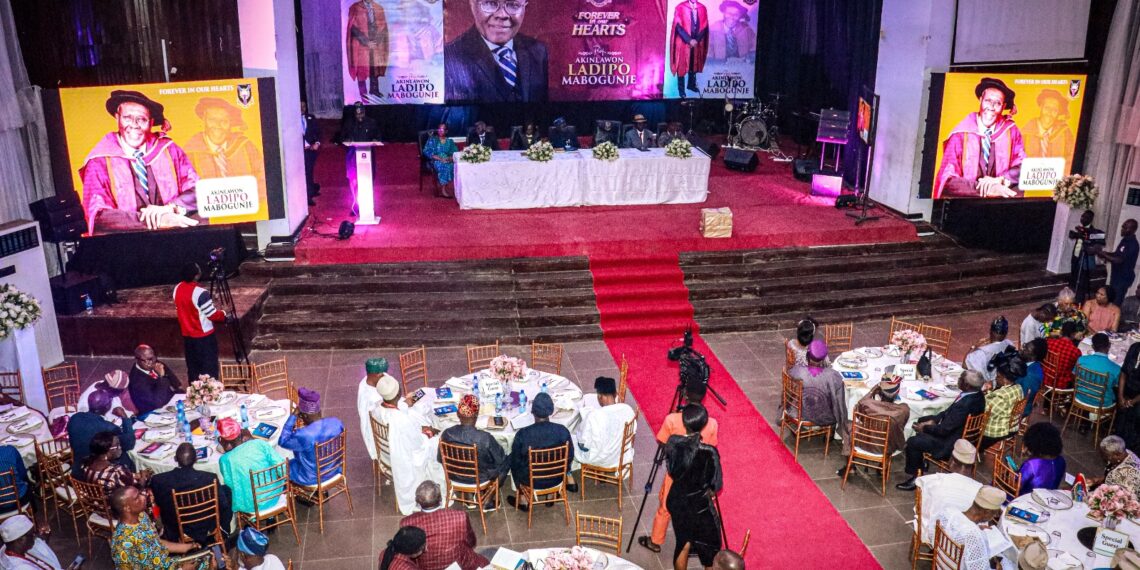
Cross-section of guests at the event on Wednesday.
To celebrate Mr Mabogunje’s legacies the dignitaries gathered on Wednesday at the Trenchard Hall of the University of Ibadan where the first memorial lecture in his honour was held.
Former Nigerian President Olusegun Obasanjo; former Chairman of the Governing Council of the Obafemi Awolowo University (OAU), Ile-Ife, Yemi Ogunbiyi; former Executive Secretary of National Universities Commission (NUC), Peter Okebukola; Vice-Chancellor of University of Ibadan (UI), Kayode Adebowale, and former Vice-Chancellor of University of Lagos (UNILAG), Akoka, Rahman Bello, were among dignitaries who on Wednesday celebrated the legacies of Africa’s first Professor of Geography, Akinlawon Mabogunje.
Mr Mabogunje, father of the incumbent UNILAG Vice-Chancellor, Folasade Ogunsola, was a friend and an associate of Mr Obasanjo.
He was celebrated for what many of his old students, mentees, associates and scholars described as his huge interventions in the urbanisation drive in Africa.
To celebrate Mr Mabogunje’s legacies, the dignitaries gathered on Wednesday at the Trenchard Hall of the University of Ibadan where the first memorial lecture in his honour was held.
Mr Obasanjo, whose prerecorded remark was played at the event, was also represented by Mr Okebukola, who spoke glowingly about the late scholar.
He described the Mr Mabogunje as a friend, confidante and a true compatriot who he noted gave his best in service to his community, profession and humanity at large.
Memorial lecture
A professor of Urban Management and Governance at the Department of Urban and Regional Planning at the Faculty of Environmental Science, UNILAG, Taibat Lawanson, was the guest lecturer at the event. She spoke on the theme: “Pathways to Sustainable Urbanisation in Africa: Leaning on Akin Mabogunje’s Intellectual Legacy”.
Ms Lawanson, whose lecture was drawn from the research legacies of the late scholar, decried the consistent failure of stakeholders to engage, adopt and implement research findings and recommendations by academics.
She highlighted some of the many milestone contributions of Mr Mabogunje especially in the development of Abuja as Nigeria’s Federal Capital Territory, and the Lagos Megacity, “his advocacy for land reforms, poverty alleviation, community development and traditional governance as well as industrialisation, among other areas.”
She said Mr Mabogunje’s book on urbanisation in Nigeria remains as relevant today as it was when it was written 50 years ago.
“I dare say that on the face of the earth, there is no student who has passed through a planning programme, a geography programme that has looked at the geography of the world, that has not had that recommended reading, and that is the gift that Professor Mabogunje gave to us: an opportunity for us to think about African urbanisation through a lens of Africa that is not reliant on theories from abroad,” she stated
Championing African-centric urbanisation theories
The guest speaker said Mr Mabogunje’s contributions to the theoretical landscape of African urbanisation is huge.
She noted that the late scholar’s dedication to redefining the field challenges disciplinary approaches to understanding the conventional adoption of theories primarily rooted in the global north, which she said frequently fail to capture the complexities of urbanisation in Africa.
“A review of his book on Urbanisation in Africa introduces the comparative theory and sophisticated methodology, and yet stresses principles and concepts of economy, location, and specialisation,” she said.
According to Ms Lawanson, Mr Mabogunje was primarily recognised as a geographer, saying his intellectual reach extended far beyond the confines of a single discipline.
“He championed the importance of multidisciplinarity, urging scholars to transcend disciplinary boundaries and adopt a more holistic approach.
“In Maboginje’s quest to understand the intricacies of African urbanisation, he advocated mixed-methods analysis, combining historical and quantitative methodologies to gain a comprehensive understanding of the development processes, which included moving beyond economic indicators to place a central focus on the well-being and empowerment of individuals and communities,” she said.=
Family launches Akin Mabogunje Foundation
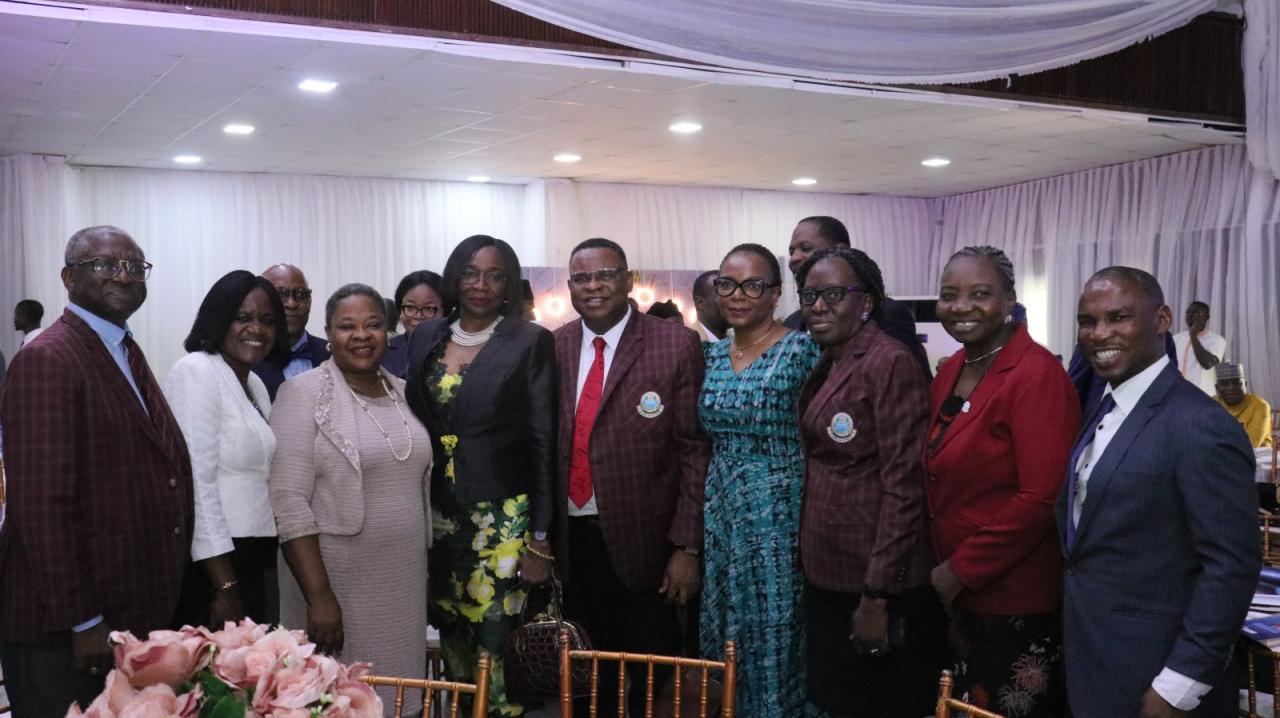
The event, which was graced by the management and staff of UNILAG and the university’s College of Medicine, witnessed the presentation of two books in honour of the deceased.
One of the materials presented included the “Special issues of Benin Journal of Geography, Planning and Environment,” as well as the Mr Mabogunje’s last book titled, “Egba Palimpsest”.
Meanwhile, Mrs Ogunsola, who is the first child of the late professor, also presented a foundation in honour of the late patriarch of the family.
Christened Akin Mabogunje Foundation, Mrs Ogunsola said the initiative is intended to “immortalise, preserve and sustain the many intellectual milestones and legacies of their father, Professor Akinlawon Ladipo Mabogunje.”
About Mabogunje
Akinlawon Mabogunje died at the age of 91 on August 4, 2022, and was a prominent Nigerian geographer known for his significant contributions to the field and various leadership roles.
He was the first African to become the president of the International Geographical Union, showcasing his global recognition and influence in the field of geography.
In 1999, he achieved another historic milestone by becoming the first African to be elected as a Foreign Associate of the United States National Academy of Sciences, which highlighted his remarkable contributions to the scientific community.
He authored the book “Urbanisation in Nigeria” in 1968, where he explored the relationship between urbanisation and state formation.
He argued in his book that urbanisation required specific conditions, including a surplus of food production, a powerful group to control that surplus and maintain peace, and a class of traders or merchants to support specialists.
Mr Mabogunje served as the Chairman of the Ibadan School of Government and Public Policy.
He held several key positions in various government and academic institutions, including the Western Nigerian Economic Advisory Council, Federal Public Service Review Commission, Nigerian Council for Management Development, and the National Board for Community Banks, among others.

